Featured

How Working at a Writing Center Prepared Me for a Career in Healthcare

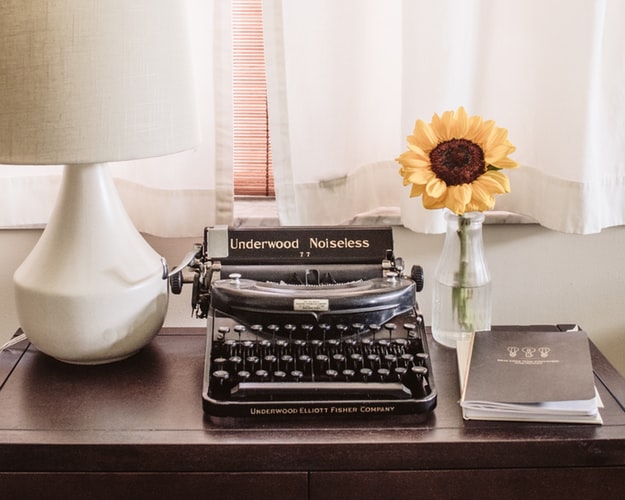
Photo by: Trent Erwin (https://unsplash.com/photos/UgA3Xvi3SkA)

In reflection on my transition from college student to full-time medical scribe, it is with gratitude that I look back on the opportunities that molded my career path. Most people move forward in healthcare because of strong mentors, internships, years of schooling, and a hearty dream. I, conversely, chalk up my occupation to both a pandemic-era plot twist and, honestly, a life-changing, part-time job.

During college, I had no aspirations to work in the medical field—let alone optometry. Had I, I would’ve taken advantage of Marian University’s prestigious nursing program. My heart rather wanted what Lois Lane wanted: a career in reporting and writing. When I was first nominated to be a writing center tutor in my sophomore year, I took it as what seemed to be an ideal resumé-builder for my future career as a journalist.

In retrospect, young me was likely most thrilled about having a paid on-campus job. The joys of tutoring, learning pedagogies, and interacting with the community would manifest in an abundance of ways later. Entering the position, I felt a nervous flush of burgeoning emotions akin to a freshman stepping onto campus for the first time.

Little did I know that its merits and hardships would sharpen my skills beyond the ink pen and give me the wisdom to excel in a field entirely foreign to me. The transition from graduation to a new job was less than stellar—as many post-Covid graduates can attest. But today, in the quiet moments of clinical chaos, I smile sweetly at the rich parallels that make me feel as though I never left the Writing Center’s cozy and enriching cubicle:


  1. Sensitivity: In light of clients and patients alike, respecting the dignity of every individual is the pinnacle of ethical practice. My time as a tutor was my first introduction to the dynamic of being a professional offering a service to a client. The Center brought in students of varying confidence levels in their writing, and to each, I had to be sensitive to their comfort zones. Only by meeting a student where they were could I ever hope to improve their works-in-progress and maximize their strengths. Likewise, as a paraoptometric, I meet each patient with varying degrees of health. Assessing their specific needs and implementing the appropriate standards of care for present and future care makes a world of difference for each person.
  2. Respect for Culture: Operating out of South Bend-Mishawaka brings a similar air of diversity as working in the robust city of Indianapolis. My time at the Writing Center was tremendous preparation for working with people of all different backgrounds—from locals to exchange students to refugees. Outside the campus, the Center also taught me the art of serving with the Near Northwest community of Indy—offering me volunteer opportunities, ways to connect with my team, and learning strategies to better build up the community. This motivation undoubtedly transferred into my current field. I am constantly working with my small, dedicated team to cater to an ever-growing population. We work so hard to try to give ALL patients a positive experience and help provide them with the best (and most updated) medical expertise. And as a result, I have learned so much more about my community and how much I love playing a role in their care.
  3. Communication: The Writing Center was my rock for communication practice—infinitely more than any retail or fast food job. Never before had I had a job that made me learn theories and pedagogies before engaging with clients. Never before had I had mentors and colleagues who knew so much about the craft that I could soak up their expertise and ask limitless questions. And never before did I have to embrace one-on-one work as a mentor myself. Daily verbal and written communication were instilled in me as a tutor, and even now as a scribe, I find myself performing similar skills with a greater air of confidence. Speaking to patients, making referrals, performing pretesting, and actively training/educating team members are all daily acts that freshman me would have feared. In the same stride, I have learned the value of becoming as informed as I can be on ocular health while looking to my doctor and team for wisdom and guidance.

In the grand scheme of life, short-time experiences can be imperative pillars of insight and inspiration. Had I not taken a chance on the Marian University Writing Center (and vice versa), I might not have had the necessary skills and experiences to step into healthcare. And within the same breath of gratitude, I am eternally grateful to my eye clinic for taking a chance on a newbie like me. For its small institutions like these—those fueled by passion and goodwill—that young people like me have the opportunity to explore new fields and make positive influences in our communities.
Featured

My First Blog Post

An Introduction to “The Writer’s Desk”

“Everybody walks past a thousand story ideas every day. The good writers are the ones who see five or six of them. Most people don’t see any.”

— Orson Scott.

Hello friends! If you need a friendly reminder, my name is Alyssa Chartrand. I am the alleged adult running this blog, which I entitled “The Writer’s Desk.” This is my first attempt at writing to Marian University (primarily) to cover newsworthy, writing-related endeavors taking place or inspired by this campus.

To kick off this new series, I suppose it is in both of our best interests if you know what “The Writer’s Desk” is all about and why I am doing this.

First, a little about me and my relationship with writing: I am in my third and final year of studying writing and communication at Marian University in Indianapolis, Indiana. Throughout my shortened years of schooling, I have acquired a small inkling of knowledge about writing and so I thought I would fool you with meaningless stories. Kidding, I am very diligent in my studies. I am also an editor and a writing center tutor so all I ever hear about is writing and I am dying to share.

Thus, when the opportunity came to write a blog for my Digital Journalism course, I knew I had to write from what I knew: writing. But right away I struggled to think of how the heck (sorry, I must write in respect of my Catholic institution) I would write sensational stories about an activity and technique that we utilize most notably in the classroom.


Becoming Inspired by Writing Bloggers

When I did not know how to get feet wet (or, dare I say, dip my quill pen into the pool of ink), I did a Google search for writing bloggers. My exact first keys words were: blogging writers who write blogs about writing. Not very efficient at first, until I met my hero: Emily Krohn, the genius behind the blog “Thriving and Writing”.

I commend you, madame, for giving me some groundwork upon which to base my ideas on. The speechwriter, content marketer, and novelist lays out a series of blog posts that offer readers a more in-depth understanding of how writing is applicable in daily life, in past inspirations, and in the future workplace.

I think many of you would find her works to be relaxing and enjoyable. They are short too, so you will have plenty of time afterwards to procrastinate and watch Netflix. She seems to unintentionally touch on various aspects of collegiate life. For example, as many of you at this point of your schooling are Starbucks connoisseurs, perhaps you too will find resonance in her “Instant vs. Brewed Coffee and How it Applies to Writers” post.

Or, if you are affiliated with any religion or are part of the San Dam program, maybe you too have taken up journaling to help with your spiritual life but struggle to keep it up daily. Further, perchance you have considered journaling as a means of coping with anxiety and depression. Either way, I highly encourage you to check out her blog post, “Journaling: The Hardest Part is Getting Started.”

All of her blogs seem to follow the common trend of writing despite her not being a college student. I believe her ideas reveal the very real-world application of writing to our own everyday lives and push the creative agenda.

Writers of writing are tough cookies to find on search engines, especially those writing on behalf of a collegiate audience. Those I did find were diverse in their perspectives. Some spoke highly of the combination of writing with social justice efforts. There was one that connected songwriting with mental health reparation. Two or three others spoke about how editorial practice changed their whole mindset about writing. These subjects would only scratch the surface of potential.

I eventually found the holy grail— “The Writers College Times.” A blog website bent on bringing the gift and uses of writing to a college audience. Each article sparkled with relevance. One hit the nail on the dreaded writer’s block. Another enlightens our tech-savvy generation with strategies for writing effective social media content. For me as a reader, all these articles reminded me of how useful it is to build up my writing capabilities.

A common theme that I notice among the latter of the blogs is that any college student could find these subjects interesting.

As students, we so much crave a creative outlet from our studies. In terms of essays, we push through them and as a consequence we become drained of the writing process. We scoff at the thought of us being writers after the assignment is turned in. Or, if we are considered to possess more than adequate talent in the writing department, we often allow the voice of anxiety to tell us that we are not (and will not ever be) good enough.

How can students be expected to write more if we do not receive a consistent reason to look to writing as a tool and a rock to build ourselves up on? How can we learn to become more effective writers if formatting and grammatical structure are considered more important than our desire to find inspiration? These are just a few burning question fueling my need to give more exposure to the art of writing.


How I Plan To Build Up “The Writing Desk”?

As a tutor, I have seen your fleeting interest in overwhelming essays. I have also quite often heard the phrases that make rigid my soul, such as “I am not a writer” and “sorry, I am just really bad at this.” As a student, I am hypocrite who has said all those things and more. But, nonetheless, I have had the fortunate of seeing how writing has motivated and empowered our community. In the present, I see so much of it in the works and I have a long list of what I might report on.

Now it is your turn to see it.

If you have got this far in my blog, I commend you and I pray that you will give the rest of my blogs a go. “The Writer’s Desk” is scheduled to be posted every Sunday from now until May. While the link will likely make it on the social media of Marian students, I invite you to share my words of wisdom with anybody you know who is need of a reason to experience writing in a new light. I want people to see the beauty of writing in the modern world and in the context of everyday life.

Thank you for reading! Stay tuned for more. Subscribe below to get notified when I post new updates.


  1. mari ovi's avatar

    Hi, Dr. O here. Great job! This was an excellent first post. I’m invested in the blog and the subject.…

Working 9 to 5: A Cup of Ambition for the Struggling Writer

“You’ll never do a whole lot unless you’re brave enough to try.”

—Dolly Parton, an American singer, songwriter, multi-instrumentalist, actress, author, businesswoman, and humanitarian (yes, she deserves this whole introduction!)

You’ve Got Passion & Vision

Working 9-5 is never an easy task. Neither is taking 12-19 credit hours in a given semester. Couple that with extra-curriculars, internships, family & religious obligations, and social interactions. If you think about adding a daily dose of writing, you will likely concur the remaining hours are for sleeping, eating, and/or studying. Fair thinking, but you are FAR more capable than you realize!

I took part in this restricting mentality, so much so that it has taken me nearly a year to get back into the swing of writing. What have I done instead? The moment the diploma hit my hands, I was back to working 40-50 hours a week to pay off my loans. Today, I am with a blossoming career in ocular health—one rich in purpose, but quite physically and mentally demanding.

And it is a traditional 9-5 occupation. As such, in the remaining hours of my day, I am catching up with family, practicing hygiene, and perusing social media.

Then as my head hits the pillow, I let insomnia take over for roughly 15 minutes so I can brainstorm story ideas, character development, and plot twists for a project I abandoned in 2020. As I enter dreamland, I merely bury it in the back of my subconscious to think about in the coming months. Why don’t I write out the ideas? Why not write the damn book? I may have the passion and the vision for what I want, but why do I always let the excuses run rampant?


Make Something of Your Own Now

If you resonate with my experiences, perhaps you too can find ways to cut back on the negativities and distractions.

Maybe hours cannot be helped—like scheduled work hours or family time. But if you take a moment to reflect, how many hours are spent, say, on TikTok? Instagram? Twitter? Computer and technology usage has advanced tremendously since the COVID-19 pandemic. 2021 data from the Pew Research indicates that about 31% of adults are constantly online while 48% are on several times a day. Where do you fall in this range? How much time is wasted? And have you considered channeling any mindless scrolling into purposeful typing?

And this is not judging. I spent a half-hour on Instagram before writing this. I am a faulty 31 percenter.

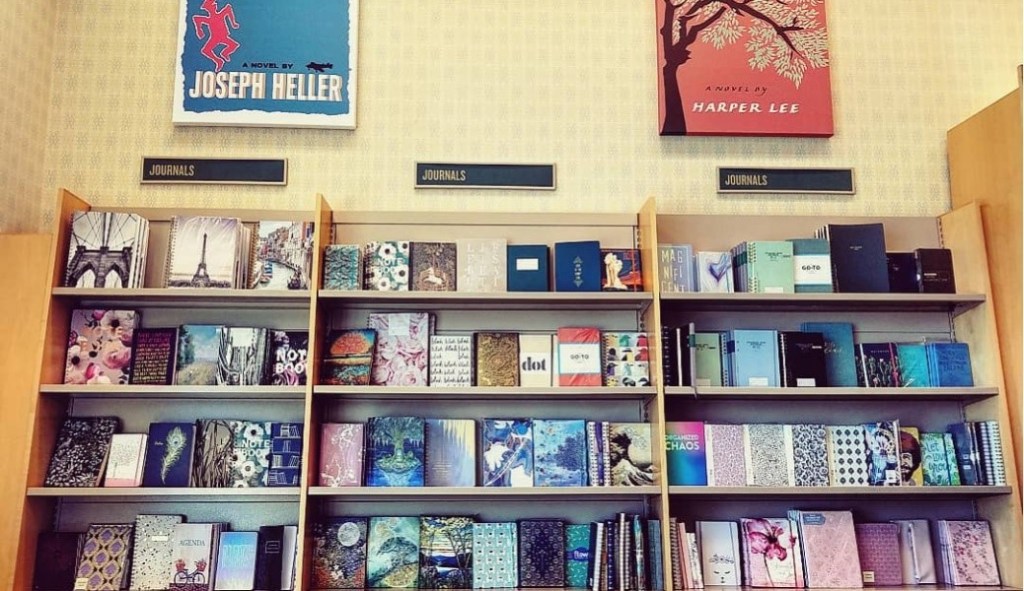
But if you are spending too much time online, why not cut back via old-school handwriting? Barnes and Noble and Target didn’t generate the cutest notebooks on earth for you to just pass them by. AND—there are considerable benefits to handwriting your projects!

The National Pen Company wrote a compelling article suggesting that “handwriting [allows] for better short- and long-term memory recall because they contain your own words and handwriting.” Of course, they’re more suggesting this for in-class notetaking, but placing your works at the forefront of your mind is key.

OR, if social media is not the barrier to your writing delays, could it be a loss for ideas? No muse to stir up your creative juices? If you feel this way, recall when was the last time you sat down to a good book. Countless articles suggest that reading helps improve our writing by helping us to make connections to our own experiences and emotions. I wholeheartedly believe opening up a book opens up a new world of opportunity.

Reading could take maybe an hour or less a day to inspire you. There just HAS to be some time. After reading The Girl They Left Behind by Roxanne Veletzos earlier this month, I have found that I am itching to invest my time in writing WW2 historical fiction. Ask yourself what kind of book/work you see yourself writing.


Gonna Change Your Life

There are many more ways to invest in yourself. You just have to find your motive and make the time. If you think of your place in the universe—rooting it in your convictions, your mission, your nonstop movement through a demanding world—I hope you can see that there is an overarching need to bring your ideas to life in the time you have. It is pivotal that as a writer you make time to create—lest the world loses a timeless relic of what could have been.

So yes, your schedule is busy. Your work and personal life need attention, but so do your ideas—no matter how small. You cannot invent stories in your mind only. Practice and planning go hand-in-hand. You also cannot retain the mindset that your story is not worth it. If your mind continues to dwell on a lingering idea, chances are that the universe is begging you to at least try. And you must, must try because only in doing so will you change your life.

And if that’s not enough encouragement for you—or you simply do not have the time to squeeze in your 9 to 5 hustle and bustle— reread that introductory quote one more time. Because I don’t think Dolly Parton became an American icon with a tremendous number of accolades for you to ignore her wisdom.

Making Sense of the World: Journaling for the Songwriter

“Woman in White Tank Top Holding an Acoustic Guitar” by Andrea Piacquadio | Budapest, Hungary | February 19, 2020
<https://www.pexels.com/photo/woman-in-white-tank-top-while-holding-acoustic-guitar-3768155/>

“I’ve never thought about songwriting as a weapon. I’ve only thought about it as a way to help me get through love and loss and sadness and loneliness and growing up.”

— Taylor Swift

Yes friends, I am bringing music into the sphere into writing. Though I have made clear my passion for writing, many of you might not know that I am quite passionate about music. Much like writing, music has been a big part of my life since I was a kid. I have now a lifetime of performing, singing, and songwriting under my belt, but still lack a lot of the theoretical and mechanical complexities that would come with a degree in a music field.

So, if you think I’m about to bore you with a labyrinth of music terminology, “fret” not!

Hahaha…ha see what I did there? … Okay, I’ll “refrain.” I don’t want to get into any more “treble” with you.

When I was a teenager struggling to navigate social life, family issues and high school academia, I discovered that songwriting was the best way to make sense of everything. I recall sitting on my backyard’s patio with my acoustic guitar. I would play basic chord progressions and sing quietly the words of my heart. My only audience was myself, and occasionally my dog, but it proved to be much-needed time alone.

And I know! Some of you may have never touched an instrument or hit a note correctly in your life, but you don’t have to be a maestro to write a song. Songwriting often takes a great deal of time and coordination, but for an individual who’s up for the challenge it can just take the form of pouring out your emotions, feelings, or thoughts. All you need is a journal, a pen and a little magic.


The Basics of Songwriting (With/Without An Instrument)

My dad’s favorite producer and singer is Jeff Lynne, known most famously as the lead singer and co-founder of the 70’s English rock band Electric Light Orchestra (ELO). When he was a boy, Lynn learned to play his first song on a one-string Elvis guitar. To this day, the 72-year-old singer cannot read all the various musical compositions, and yet, he is one of the most commercially successful songwriters and producers of all time.

I am not saying you have to aim as high as Jeff Lynne. Unless you are devoted to a music career, in which case, I say go for it. But for this writing blog, I encourage you to start from the small—write some lyrics!

Lots of classic rock and pop songs take this outline, which was taken from “Music Industry How To“. In-depth understanding of each one is also found on the page:

  1. A Verse
  2. A Chorus
  3. An Intro (also called the Introduction)
  4. An Outro
  5. The Breakdown/A Bridge
  6. A Pre-Chorus
  7. The Drop

When you listen to music, you can often identify these transitions. They are often written like a poem; they have a certain number of stanzas for every line. But, like free-verse poetry, you as the artist have the option of being all over the place if you so like. Still I thought you might enjoy a basic structure.

If you have an out-of-tune guitar or ukulele lying around your home, you can always tune it up with the “GuitarTuna” app and get yourself going with a nice, gentle strum pattern. The Down-Down-Up-Up-Down-Up strum pattern is most famous for simplicity:

<https://www.guitarlessons.com/guitar-lessons/guitar-lessons-for-beginners/5-essential-strumming-patterns>

The staple-looking one is a strum down. The “V” is strumming up. If you don’t have a guitar, dust off your piano. Or grab your uncle’s banjo or your great Aunt Mildred’s harpsichord. If you don’t have an instrumental, consider some instrumental tunes on your favorite music browser.


Finding Inspiration From Home & Nature

However you get that musical tune in your head, let it guide you. Your next step after grabbing a journal and a writing utensil is to think. Sit somewhere you can draw inspiration from—your backyard, your room, by the fireplace, etc. Think about your current situation. Ask yourself questions like: How am I holding up with the world’s chaos? My own chaos? Am I being treated fairly? Am I treating others fairly? Write it all down.

Not to sound like a therapist, but consider what emotions are you feeling: anxious? Paranoid? Joyful? Angry? Whatever words come to mind, write them down. How would you describe the setting around you? Constricting? A peaceful dwelling? A temple of awesomeness? Write it, darn it! Then, contemplate why you’re feeling these things. Create a cluster around a particular emotion or question. For example, it may look like this as a sketch:

“My Songwriting Thoughts on the 2020 Pandemic” by Alyssa K. Chartrand on Jason Davies cluster program <https://www.jasondavies.com/wordcloud/>

After coming up with a collection of thoughts, use your notebook to write out your lyrics. Songs serve as the creative bridge between our hearts and minds. Let your heart do the feeling and let your mind be creative in placing the words. It may take some time, but in the end it may be worth it! Challenge yourself to work within the parameters of the previous outline, if you’d like. Capture the moments and feelings of 2020!

Maybe your song will make no sense. Maybe it’ll be too cliché. Maybe it won’t make it into the Rock & Roll Hall of Fame. So what! Write because you want to!

If you feel comfortable or excited about your finished piece, share it below! All writing works are welcome on this corner of the blogosphere! I may even share my own! For more guidance on the songwriting process, check out Connolly Music’s article on the 6 steps to basic song writing.


  1. mari ovi's avatar

    Hi, Dr. O here. Great job! This was an excellent first post. I’m invested in the blog and the subject.…

The Gift of Charitable Writing: Spreading Hope From Home

“Boy in Yellow Crew Neck T-shirt Writing on White Paper” by Julia M. Cameron | Taken March 28, 2020
<https://www.pexels.com/photo/woman-in-yellow-crew-neck-t-shirt-writing-on-white-paper-4144173/>

“Not all of us can do great things. But we can do small things with great love.”

—Mother Teresa

What My Final Semester Taught Me

As mentioned in earlier blog posts, 2020 has not been a picnic for anybody. As a senior in my final semester of college, I have been struggling for nearly a month and a half to cross the finish the line. Though I lost an abundance of opportunities I hoped to treasure (like commencement, senior retreat, and saying goodbye to all my Marian friends), I did find a flicker of hope in my ongoing English class.

I have had the privilege this semester of engaging with my ENG 322: Line Editing course. During this class, I learned a plethora of editing processes I might share in later blog posts, such as conceptual editing, copy editing, making style sheets, and so forth. These processes were implemented in an ongoing project known as the Indiana Prison Writers Workshop.

Our project this semester is to edit and piece together a collection of prose written by inmates at Pendleton Prison. It is to be published this coming summer.

While I am a sucker for editorial knowledge, I reflect back on this experience as more of an eye-opener for the therapeutic power of writing. My responsibilities included gathering and transcribing stories from those who have been incarcerated and shut out from society. I experienced a range of emotions as I read through the realities of prison life, childhood narratives, and optimistic goals for the future.

This workshop was created with the intent of offering an outlet for “those who have experienced violence in their communities” and to help participants “find confidence and courage to write from their hearts.” As one of the editors, I can attest to the truth of its mission. This project revealed to me the power of writing for those suffering or struggling. It is an outlet for emotion and feeling that connects communities and builds up self-esteem.


Building Up Communities From Home

In this uncertain year of 2020, suffering is all around. To overcome the burdens of COVID-19, we must stay positive and do our best to uplift ourselves and others. And what better way to do so then with an activity you can do from home.

I have decided to name this home-style writing: charitable writing. Charitable writing is any kind of written activity by which you help lift up others with kind words. For me, this looks like bringing the voices of Pendleton prisoners to a broader community—all from my computer and the WebEx program. But for you, this could be writing a letter to an elderly or missed family member. Or, using an online program to write to a quarantined pen pal around the world.

I have made a fun infographic to help inspire you:

Made with Template and Artwork by: Canva

Helpful Links:

These are just a few fun ideas to be generous with your time and writing capabilities. Let me know in the comments below how YOU are engaging in charitable writing!


  1. mari ovi's avatar

    Hi, Dr. O here. Great job! This was an excellent first post. I’m invested in the blog and the subject.…

The Writer’s Guide To Giving Good Feedback

Photo Found on Unsplash by Headway at Headway, De Pere, United States
<https://unsplash.com/photos/5QgIuuBxKwM>

“Words are singularly the most powerful force available to humanity. We can choose to use this force constructively with words of encouragement, or destructively using words of despair. Words have energy and power with the ability to help, to heal, to hinder, to hurt, to harm, to humiliate and to humble.”

– Yehuda Berg

Why Writers Need Feedback

Feedback on written work has proven its unequivocal importance for all writers. Efficient feedback provides a writer with an objective evaluation of his or her work. If provided correctly, it can grant the writer an assessment of his or her own strengths and weaknesses.

Peer feedback is exchanged between students by means of peer response, editing, critiquing, and evaluation. We experience this from time to time as a requirement of our courses, where our professor assigns us a partner to review their work and give them feedback. Sometimes we find that the feedback is helpful, but more often than not we experience our partners just throwing in random feedback to accomplish the assignment.

We sometimes have the same impression toward our professor’s feedback— we find it too long, too confusing, or too hypercritical! I have had my fair share of rude educators over the course of my lifetime, but I believe some simply do not have not perfected the art of providing feedback.


An Understanding of Writers’ Frustrations

For students, feedback may be less than stellar. You may or may not implement what has been written in reflection of your work. However, for writers, feedback is a fundamental part of the writing process—it can guide us our of our frustrations and help us see as other writer’s might see our work.

I recently conducted an interview with one of my Writing Center tutees who spoke before about her frustrations with her professor’s means of giving her feedback. In our tutorial, we looked over the comments that expanded over the course of pages when the assignment itself was only two.

I felt her frustrations and I, as a tutor and blogger, saw it as my opportunity to shed light on the issue of poor feedback. Thus, I decided to interview her to shed some light on what students experience with poor feedback. Check it out below:

Video Created and Owned By: Alyssa K. Chartrand

A Guide For Providing Good Feedback For Fellow Students & Writers

The best way to understand good feedback is to learn some strategies for knowing how to provide it yourself. As promised in my interview with Ms. Colgrove, here are some ideas to help you the next time you are required or asked to give feedback. AND, be sure to share it with your friends or (if you’re daring enough) your professors to help them understand your needs as a writer and a student:

  1. Be fair and honest in your comments — Think about the writer when he or she is reviewing your words. Try to envision the writer if you are speaking directly to him or her. Tell it like it is, but be generous with words the way you would in normal conversation.
  2. Don’t focus on grammar and spelling the whole time — Don’t stop to comment for every grammar and/or spelling issue you come across. For this, you could early-on use comments like, “be sure to double check small issues or grammar” or “online programs like Grammarly work wonders!”
  3. Share as much positive feedback as possible — Don’t stick to just sharing the things you do not like or wish to change about a writer’s work. This only proves detrimental to the writer’s self esteem. Stop every now and then to say, “Hey, I really like how you…” or “What an interesting concept here!” But be honest with the positiveness.
  4. Refrain from interjecting your own biases/opinions/emotions — Sometimes a writer may ask you for particular feedback about the ideas he or she is bringing to the table. However, sometimes a writer is not asking for a dismissal of what is written. If you are unsure your objective for feedback, talk with the writer first. Offer words that can be constructive, but don’t argue in the comments for all the points you disagree with. Remember, what you are reading is the writer’s work, not your own. (P.S. Do state if there are inaccuracies or incorrect information that is being presented as fact. Or, if there is instances of hatred, bigotry, or words that condone hatred toward somebody else.)
  5. Do not overload the page with comments — A writer takes into consideration your “words of wisdom,” however, be conscientious of the writer’s time and energy. If you include a whole bunch of comments that suggest drastic change and then continue to push for grammatical issues, you are doing nothing but stressing out the writer. For major revisions, consider talking over your ideas with the writer in person (maybe even video feedback of you explaining areas that could be improved or elaborated on).

  1. mari ovi's avatar

    Hi, Dr. O here. Great job! This was an excellent first post. I’m invested in the blog and the subject.…

5 Tips for Avoiding Bad Writing (Academic Writing Edition)

“Student Writing on Computer” | Photo By: Andrea Piacquadio on Pexels.com

“If a man means his writing seriously, he must mean to write well. But how can he write well until he learns to see what he has written badly. His progress toward good writing and his recognition of bad writing are bound to unfold at something like the same rate.”

—John Ciardi

It seems that 2020 is not the year for college students (or anybody really). We have been hit hard by the Coronavirus pandemic and are struggling with our battles each day as we strive to navigate the new world of online school.

After attending a listening session of a fellow scholarship group on WebEx and being attentive on social media, I discovered how much people are having complications with the new state of reality. For those at Marian, it appears that many are drained from this semester and are desperately waiting for it to draw to a close.

What I have noticed as another factor exposing our anxieties and stress is the way people have began to approach writing: quickly and less persuasively. Many students are beginning to check out of the semester and within good reason. However, as a tutor and a lover of writing, I thought what better time to put some advice out there for a struggling writer.

This blog post is entitled: “5 Tips to Avoid Bad Writing.” This video was not created to say that anybody’s writing is necessarily bad. Rather, I made it specifically for students working on academic writing assignments, like essays and research papers. My tips to avoid the mistakes we make when we are in a hurry. My intention with the blog post is to encourage you to engage in revision and to step away from your work when it begins to tread into your already present anxieties.

Lots of my advice and feedback comes from being a student as well as a tutor. I must share a small issue I had with creating the video before you watch it. The program I downloaded was intended to be free from watermarks, but that was in fact not the case. So I apologize if the watermark is disruptive to your viewing pleasures, but nonetheless I hope it gives you a reason to keep writing despite the odds of what is happening around us.

Voila! And let me know what you think about the video or my advice in the comments below. Be sure to subscribe too!

Video Created By: Alyssa Chartrand

  1. mari ovi's avatar

    Hi, Dr. O here. Great job! This was an excellent first post. I’m invested in the blog and the subject.…

6 Strategies For Beating Writer’s Block (Quarantine Edition)

“The mind is sharper and keener in seclusion and uninterrupted solitude. Originality thrives in seclusion free of outside influences beating upon us to cripple the creative mind. Be alone–that is the secret invention: be alone, that is when ideas are born.”

—Nikola Tesla, Serbian-American Inventor

I often hear from fellow writers how they wish they had more time to be home and write. How great it would be, they say, to take a break from all the responsibilities in their life and write. And yet, I don’t think the Coronavirus pandemic was quite the solution they were looking for.

With that in mind, I do want to take this time to send positive vibes your way. My thoughts and prayers are with you, my socially-distanced readers in quarantine. I also want to extend the same kindness to your families and friends, especially to those that are elderly, immunocompromised, or hospitalized. And even to those with immune systems of steel, I wish you great hope in resuming all your responsibilities and for peace amidst your time away from others.

Just a reminder, if you struggling with anxiety or striving to understand the situation better surrounding COVID-19, check out the CDC’s tips and data.

I do hope my article offers you some brain food or temporarily frees you from boredom. And so I continue: If you, like me, are struggling to figure out what to do with your time alone, then have you considered… don’t hate me… writing?

While the situation wraps us in a blanket of uncertainty and dread, we can still choose to be positive and find productive things to do. If your heart still longs to write, indulge its desires. Grab your laptop (or a paper and pen), find a space in your place of quarantine and explore the creativity of your mind.

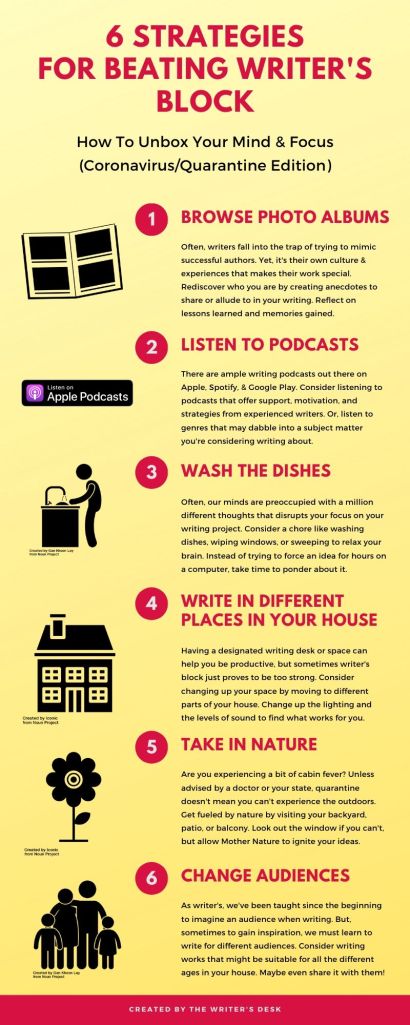
If the weight of the world and your personal stresses are tugging on your focus, fret not. It’s understandable to struggle with thinking of what to write in normal, everyday situations. Writing amidst this… well this is a whole other world of crazy to work through. And so, I took this opportunity to give you some strategies to realign your creative juices while in your home/place of self-quarantine in a fun infographic.

I am a bit of a space cadet these days (so pardon my scattered thoughts), but I also thought I should provide you a quick synopsis of what writer’s block is since I have met a few people who were actually unfamiliar with the term. Put simply, writer’s block is defined as “the condition of being unable to think of what to write or how to proceed with writing.”

This can happen from a variety of reasons, the main ones being: timing, fear, and perfectionism. Author Jeff Goins describes these in his article about writer’s block. Timing refers to the time as not being efficient for writing. There are just times one’s mind is just not well-suited for writing and that’s just a reality (like in the middle of a pandemic, for instance). Fear can be encapsulated in a quote once posted in the Marian Writing Center: “the greatest fear shared among writers is looking at a blank page.” Many writers struggle with being vulnerable and putting themselves/their ideas on paper to share with others.

Lastly, perfectionism is wanting “everything to be just right before you ever put pen to paper or touch a keyboard.” Though this may help us get the summa cum laude title in college, this mindset puts a damper on the creative writing process. So, to beat writer’s block is to trample perfectionism.

Now that you have an idea of what writer’s block is and what causes it, I can now provide you my artsy solutions. So enjoy and remember: be safe and stay healthy:

Made With Canva By: The Writer’s Desk


A Little Extra Something For the Struggling Student:

I got one more thing for you, my readers! As an extension of my service as a tutor to college students, I also thought I would share with you one more infographic I created for my tutees. The number one focus of my sessions with my students since the pandemic has surrounded the complex world of Chicago Style. If any of you are struggling with an upcoming, Chicago-style paper, I think that you will find this very simple guide to the style to be a great kick start to being on track with your paper. Voila:

Made With Canva By: The Writer’s Desk


  1. mari ovi's avatar

    Hi, Dr. O here. Great job! This was an excellent first post. I’m invested in the blog and the subject.…

How To Put Together A Writing Journal

“If there is no dull and determined effort, there will be no brilliant achievement.”

—Hsun-tzu, Chinese Philosopher

Journals are considered a collection of private materials, as it includes the vast ideas and imagination of the owner. Journals are used for a variety of purposes, such as for note taking, jotting down dreams, and making sense of life’s complications and promises (like a diary).

For writers, we have lucked out in that journals can be used for these things and much more! Keeping a writing journal is a commitment, but it does open up a condensed space upon which a writer can brainstorm ideas, record deep thoughts and feelings, sketch out the way characters look or a storyboard, or jot down outlandish ideas.

There is no one way to record in a journal. Most writers, however, aim to write by hand whenever possible, so there minds are not boggled by the white screen of a Word processor. Nevertheless, there are online outlets and apps for the tech-reliant writers.

Outside of just writing about story ideas, writers may also use their paper as a space to write for twenty minutes a day or to compose daily challenges. Sometimes other agenda items are also stored, as to help a writer determine what part of their date to dedicate to writing.

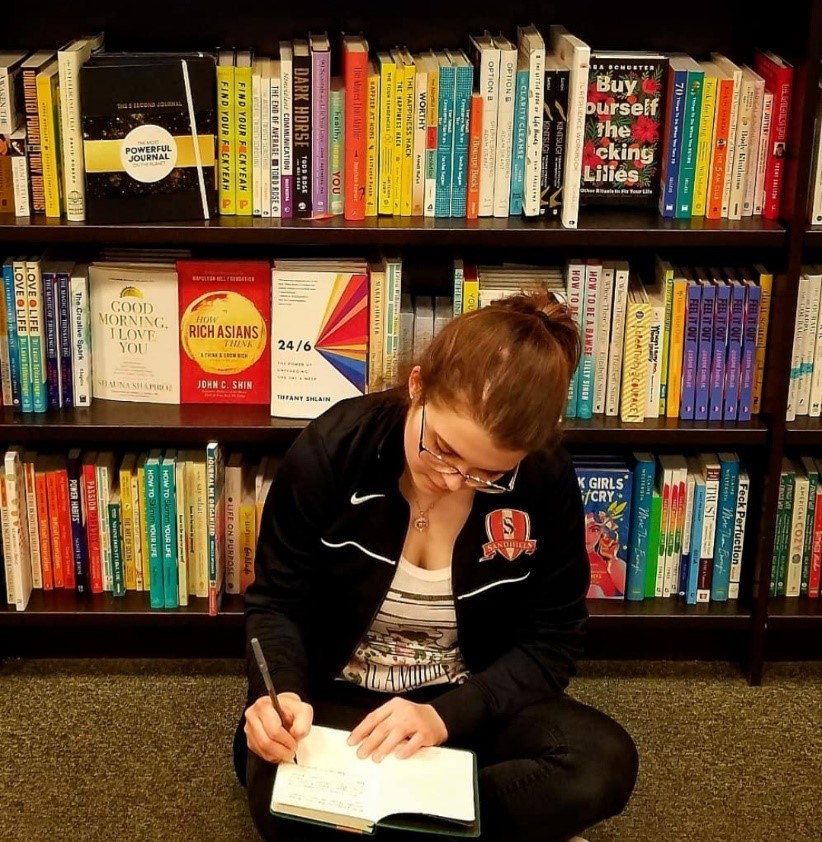
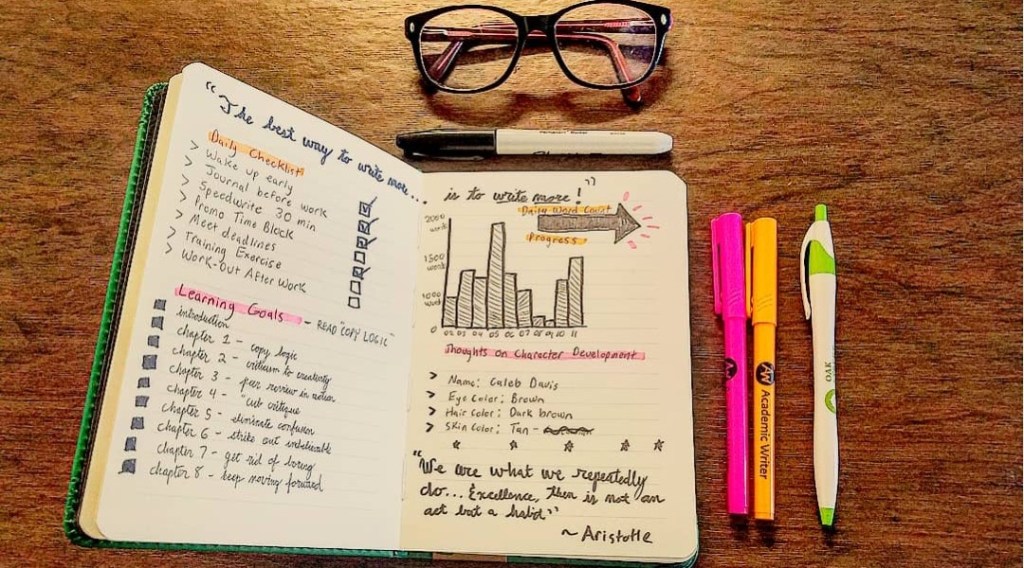
It is important to know that there are no rules when it comes to journaling. As long as you have commitment in your heart and a pen in hand, there is nothing that can stop you from practicing the art of journaling. But, if you are unsure of where to begin, I have included a slideshow to give you ideas and clarity about starting the traditional journaling process:


Gallery of Journaling:


  1. mari ovi's avatar

    Hi, Dr. O here. Great job! This was an excellent first post. I’m invested in the blog and the subject.…

A Modern Public Action Writing Story

Writing For Community Engagement Pt. 2

“The true alchemists do not change lead into gold; they change the world into words.”

—William H. Gass

This podcast serves as part 2 of a special edition blog for The Writer’s Desk. While the previous podcast discussed public action writing and the importance of integrating knowledge of writing into various educational settings, this blog expounds upon the idea of service and writing.

In it, we will explore a previous Marian student who uses his position as the Assistant Writing Center Director at Marian University as well as his love of writing to help give back to the Near Northwest Community through food access initiatives. It also shows how college education at Marian played a big role in his present service activities.

Writing For Community Engagement (Part 1)

An Introduction to the Audio Interview

“Community service has taught me all kinds of skills and increased my confidence. You go out there and think on your feet, work with others and create something from nothing. That’s what life’s all about.”

— Andrew Shue, American Actor and Soccer Player

A bonus blog for this week is part one of a two-part special on the subject of public action writing or community-based writing. This subject promotes community literacy, advocacy, and ethnography in a plethora of ways. At Marian University, service goes hand-in-hand with the Franciscan value of Responsible Stewardship. This is why so many groups and clubs on campus choose to go out and serve their communities.

For most Marian students, Martin Luther King Jr. Day of Service is a day to go to a designated area and perform service on a day that would otherwise just be spent on homework or leisure. For San Damiano Scholars, such as myself, service is a HUGE component for fulfilling the program’s goal of making “future leaders of the Catholic Church.” Thus, I have embarked on service-oriented missions to Oldenburg, Indiana, Hope Center Indy, and even to the Exodus Refugee Immigration Center.

One thing that San Dam taught me is the importance of reflection. With every experience I participate in, journaling is always stressed in the end. For them, it is often the encouragement of taking note of how we might have experienced God in others or how we are fulfilling God’s works. I think this is an important activity for the formation of faith. However, for students that are looking to gain valuable insights into service or hope to change the world by beginning in their communities, I think journaling and writing are key catalysts for success.

To expound upon the applicable nature of writing in community service, I have consulted with Professor Mark Latta, the Director of the Marian University Writing Center, a Marian English Professor, and an active member of community engagement in the Near Northwest Community. He offers insights into how he integrates service work into his pedagogies, or teaching strategies. He gives his background on how he became involved in service, how he continues to be passionate about it, and most importantly gives writers a reason to serve their communities.

Instead of my usual writing, I have decided to turn my interview into a podcast so you can hear the sage words of advice from Professor Mark Latta. Be sure to comment your thoughts on public action writing or ideas for how students can become more involved in service. Part 2 will appear next week to show an example of how a previous student uses writing to engage in community service.

SoundCloud Podcast by Ally Chartrand (i.e. myself)
I own the rights to this podcast,

  1. mari ovi's avatar

    Hi, Dr. O here. Great job! This was an excellent first post. I’m invested in the blog and the subject.…

Design a site like this with WordPress.com
Get started